
Franklin Parole and Probation
Parole and probation can both place a released Franklin County person under rules in the community, but the legal source differs. Parole is release from a state prison term before the maximum sentence ends. The Georgia State Board of Pardons and Paroles makes that release decision, and the Georgia Department of Community Supervision, or DCS, provides field supervision. Felony probation is imposed by a judge. DCS also supervises many felony probation sentences, including split sentences that begin in custody and continue on probation.
Local probation is a separate channel. A misdemeanor or other locally supervised case may point to the Northern Judicial Circuit Probation Office rather than DCS. The Franklin County court docket and sentencing order are the best way to identify the authority. A jail release alone does not prove that supervision began or ended.
| Record type | Who orders it | Where to verify |
|---|---|---|
| Parole | State Board of Pardons and Paroles | Parolee Search, TPM record, and DCS |
| Felony probation | Sentencing court | Court docket and DCS |
| Local probation | Local court | Court docket and local probation office |
| Discharge | Board, court, or supervising authority | Final order or official agency record |
- Parole
- Conditional release from prison while part of the sentence remains.
- Probation
- A court-ordered sentence served in the community under stated conditions.
- Discharge
- The formal end of supervision, not merely release from jail.
- Split sentence
- A sentence with a custody term followed by probation.
Verify Franklin Post-Release Supervision
Start with the kind of custody the person left. Someone released from the Franklin County Jail may have bonded out with no community supervision, begun probation under a court order, transferred to GDC, or entered another agency's custody. A person leaving a Georgia prison may be on parole, may have reached the maximum release date, or may begin a probation term. These paths produce different records.
- Search the Georgia parolee database. Match the full name and any identifiers before treating a result as the same person.
- Review the Franklin County docket route for the sentence, probation terms, revocation entries, or a final disposition.
- For felony probation or parole, contact the DCS Elberton Field Office, which serves Franklin County.
- For a local probation sentence, contact the Northern Judicial Circuit Probation Office location in Carnesville.
- Ask for the official discharge or revocation record when a firm status is needed. A missing web result is not proof that supervision never existed.
The Franklin County released inmate search path can help distinguish release from transfer. The county booking and release record establishes what happened at the jail. The court or state supervision record then explains what followed.
For a prison case, the Board's TPM information answers a different question from the parolee database. A TPM concerns possible future parole review. The parolee database concerns people actually shown under parole supervision. Neither replaces the sentencing record. When two sources appear to conflict, compare the effective dates and ask the agency that created the newer record.
Franklin Felony Supervision Office
Franklin County does not have its own DCS field office in Carnesville. The Elberton Field Office serves Franklin, Elbert, Hart, Madison, and Oglethorpe counties as well as the Northern Circuit. It handles community supervision rather than jail custody. Staff can provide office context, but the court sentence or Parole Board record remains the source of legal authority.
Georgia DCS, Elberton Field Office233 N. Oliver Street
Elberton, GA 30635
Phone: 706-213-2032
Monday-Friday, 8 a.m.-4:30 p.m. Eastern
Bring or provide enough detail to separate people with similar names. Useful facts include the full legal name, date of birth, GDC number if known, court case number, and sentencing county. Do not assume the nearest office holds the file. DCS can route a valid inquiry when supervision has moved.
Franklin Local Probation Office
A second office sits in Franklin County itself. The Northern Judicial Circuit Probation Office lists a Carnesville location at 9592 Lavonia Highway, phone 706-384-3703, with service by appointment. This is not the same agency as DCS. It may be the right route for misdemeanor or other local court supervision, while DCS handles state parole and felony probation.
Use the sentencing order to avoid calling the wrong office. The Franklin County Clerk processes criminal court filings and maintains court records. A docket entry may name the probation provider, show the length of the term, list a revocation filing, or record the final disposition. The probation office can then address supervision details within the limits of what it may release.
The local office is listed as appointment-only. Call before traveling and have the case number ready. If the record instead names DCS, use the Elberton office even though it lies outside Franklin County. The office location follows the agency's service map, not necessarily the courthouse where sentence was imposed.
Franklin Supervision Violations
Conditions are the rules attached to release or a probation sentence. They can include reporting, approved travel, treatment, payment, or other case-specific duties. Only the order and supervising officer establish the actual terms. General web descriptions cannot show whether a particular person complied.
An absconder is a supervised person alleged to have stopped reporting or left supervision without approval. That label is not the same as a new conviction. A violation may lead to a warrant, a hearing, changed conditions, return to custody, or revocation. Check the Franklin County court docket for probation proceedings and the Parole Board or DCS record for parole matters. Georgia VINE may send a custody-status alert if a participating system reports a later jail event, but it is not a supervision-case file.
Franklin Parole Decision Records
Georgia generally does not hold a public, county-level hearing before each ordinary parole decision. Board members review files and vote. Public Board meetings and their agendas are agency meetings, not a calendar of individual Franklin County inmate hearings. The practical status tools are the tentative parole month lookup and the parolee search.
A tentative parole month, or TPM, is the month in which the Board plans final review. It is not a guaranteed release date. Final review can set a parole date, postpone action, rescind a grant, or produce another decision. A reconsideration date means parole was not granted then and may be reviewed later. A detainer can lead to conditional transfer instead of release into the community.
The Board's meeting posts show public agenda and cancellation notices. The captured official page below demonstrates that distinction.
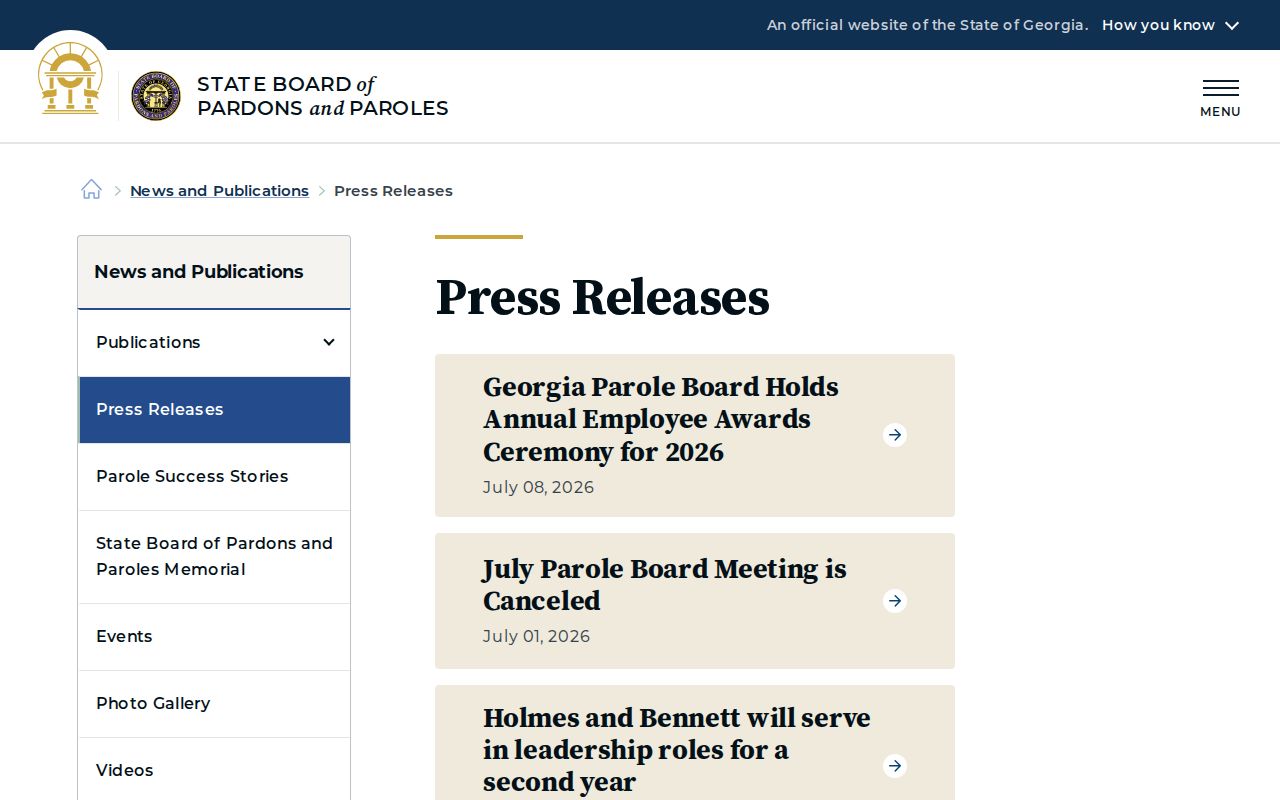
Use those posts for Board business, then use the person-specific lookup or written agency record for an individual outcome.
Possible results include a TPM, a final parole release date, a denial with reconsideration, a denial without another set review, postponement, rescission before the effective date, conditional transfer to a detainer, revocation, or discharge. Each has a distinct effect. A reconsideration date means review may occur again; it is not a promised release month. Rescission means a prior grant was withdrawn before it took effect.
Franklin Supervision Discharge Records
Supervision ends through a formal act. Parole may end with a discharge order after the sentence and supervision requirements are satisfied. Probation ends under the sentencing order or a later court order. It can also be revoked before the planned end. The mere passage of an expected date does not replace the official record.
Georgia Archives identifies clemency actions as permanent records, including parole certificates, conditional transfers, discharge orders, pardons, commutations, and revocation orders. For a Franklin County probation case, ask the Clerk for the final court entry. For parole, use the Board and DCS channels. The relevant record should state whether supervision ended, changed, or moved.
Eligibility and discharge should not be confused. O.C.G.A. § 42-9-45 sets general parole-consideration timing, subject to exceptions. O.C.G.A. § 17-10-6.1 imposes stricter rules for serious violent felonies. Eligibility only permits consideration. It does not mean parole was granted, and a grant does not mean the full sentence or later supervision has ended.
Funds After Georgia Release
State-prison release has a practical detail that does not apply to a routine Franklin County jail release. GDC says money left on a released person's prison account is moved to a Progress Card. The Georgia Release Card instructions explain PIN activation and list JPay support at 866-777-5729.
The card does not prove parole, probation, or discharge. It handles remaining state-prison funds. A parolee still verifies supervision through the Board and DCS, while a person discharged at the maximum release date should seek the GDC record that states that status.
Keep the card instructions separate from the release file. One concerns access to funds. The other establishes custody and supervision status.