
Franklin County Release Records
A Franklin County jail release means the Sheriff's Office no longer holds the person under that booking. It does not always mean the person walked into the community. The event may be a release on bond, completion of a short sentence, time served, dismissal, a judge's order, or transfer to another authority. A transfer to the Georgia Department of Corrections, another county, federal custody, or immigration custody ends the Franklin County stay but begins a different custody record.
The official Franklin County website provides pages for the Sheriff's Office, the Detention Center, and open records. It does not show an official public jail roster or a rolling list of releases. That makes the event record more useful than a current-custody screen. Sheriff Scott Andrews' office holds the local booking and release material. The Clerk's docket can show the bond, sentence, dismissal, or other court action behind that event.
Franklin County Release Types
The release authority controls where to look next. A bond release ends physical jail custody while the criminal case may remain open. Time served means the court credited enough time to satisfy the jail term. A sentence completion ends the ordered custody term. A dismissal or no-further-hold event can clear the legal basis for detention, though separate warrants or holds may still apply.
| Release event | What it means | Next record |
|---|---|---|
| Bond or recognizance | The person leaves jail while the case continues. | Franklin County release record and court docket |
| Time served or sentence complete | The local custodial term has been met. | Sentencing entry and Sheriff's release record |
| Court order or dismissal | A judge or case disposition removes the local hold. | Clerk docket and final disposition |
| Transfer to GDC | County custody ends, but state custody starts. | GDC offender search and state records |
| Federal, ICE, or other transfer | Another authority receives the person. | County transfer record plus the receiving system |
| Parole or probation | The person lives in the community under stated terms. | Parole Board, DCS, or local probation record |
Parole is conditional release from a prison sentence before the full sentence ends. Probation is court-ordered supervision, often instead of or after confinement. A discharge ends custody or supervision under the governing record. These words are not interchangeable. The exact release reason should be taken from the Sheriff's, court, GDC, or Parole Board record.
Franklin County Release Record Fields
The Sheriff's Open Records page does not publish a sample Franklin County release form. Field names therefore should not be assumed. A narrow request can identify the facts needed to confirm the event. Give the person's full legal name, date of birth if known, approximate booking date, arresting agency, case number, and booking number when available.
| Field to request | What it can establish |
|---|---|
| Booking date and time | When the local jail stay began |
| Booking number | The record tied to that custody episode |
| Charges and arresting agency | Why the person entered custody and which agency acted |
| Bond or release authority | The legal basis for leaving the jail |
| Release date and time | When Franklin County custody ended |
| Release reason or type | Bond, time served, transfer, court order, or another event |
| Transfer destination | Whether another jail, GDC, federal, or ICE custody followed |
| Court case number | The link to the court disposition and sentence |
A booking photo, hold note, property record, or account document may be requested if releasable, but exemptions and Georgia booking-photo rules can limit access. The jail record proves the county event. It may not explain the final case outcome. The court docket must be read beside it when the release reason says only “bonded out” or “per court order.”
Request Franklin County Release Records
The Franklin County Sheriff's Open Records page is the formal path because no official online release feed was found. Requests go to the Custodian of Records through the online form. The office gives written notice within three business days about whether responsive material exists and is subject to release. That notice is not a promise that every record will be produced in three days. If material is not readily available, the office may provide a later production schedule.
- Identify the person and the specific booking with name, date of birth if known, date range, case number, or booking number.
- Ask for the booking and release record, including release date, time, reason or authority, and transfer destination.
- Submit the online Open Records Form and keep a copy of the request.
- Review the written response for exemptions, estimated costs, and the production timeline.
- Compare the record with the Clerk docket or receiving-agency record when it shows a transfer or court-based release.
Records Supervisor Marcus Greer
P.O. Box 310
Carnesville, GA 30521
706-384-2525
mgreer@franklincosheriff.net
The first 15 minutes of search, retrieval, redaction, or supervised inspection work are free. Later staff time may be charged at the hourly rate of the lowest-paid qualified full-time employee. Black-and-white letter or legal-size copies cost $0.10 per page. Other formats may carry actual reproduction costs or a fee set by law. Payment is due when records are received.
Sealed, restricted, juvenile, investigative, or court-protected material may not appear in a public search. Georgia often uses “record restriction” rather than “expungement.” A missing result does not prove that no booking or release occurred. It can mean the record is restricted or held outside the public portal.
Georgia Law on Franklin Releases
O.C.G.A. § 50-18-71 supplies the access, timing, and fee framework used by the Sheriff's Office. Public access remains subject to exemptions, court orders, and laws that protect certain records. The local response may include the cost to find, copy, redact, or supervise inspection of the material.
Booking photographs receive separate treatment under O.C.G.A. § 35-1-19. That law restricts disclosure when a photo may be posted in a publication or website that demands payment or other value for removal. It does not turn every photograph into a secret record. It does mean the agency reviews the request and its statutory conditions. Release and court records also can remain available for different periods under the schedules that apply to the office holding them.
Note: Ask for the event and fields needed, not an undefined “full file,” to reduce delay and make the Sheriff's search more precise.
Franklin Release Clues in Court
Franklin County's court route matters more than it does in a county with a public release feed. The official Court Dockets page sends users to the Clerk's docket site, and the Clerk's office handles criminal filings, court records, and case processing. A docket may show a bond order, plea, time-served sentence, probation term, revocation, dismissal, or transfer-related sentence entry.
The court case persists after the physical jail stay. That makes it a strong way to explain why a Franklin County released inmate left custody. It also prevents a common mistake: treating release on bond as the end of a case. Bond changes location, not necessarily the pending charge. A final disposition, if public, answers a different question from the Sheriff's release date.
The Clerk search can be approached with a party name or case number. Compare the filing date, charge, and event history before linking a docket to the person in question. Court terms can lag behind the physical movement from jail, so a new release may appear in Sheriff records before a related docket entry is posted. The reverse can also occur when an order is entered before jail staff complete processing. Neither delay changes which office owns each fact: the Clerk records the case event, while the Sheriff records the custody exit.
Find Franklin County Released Inmates
Start with the last known facility and follow the custody chain. Franklin County does not appear to publish a recent-release list. A live roster from another state or county is not a substitute. In particular, search results can expose a Franklin County, Alabama roster. It does not cover Carnesville, Georgia.
- Request the Franklin County booking and release record if the person was held at the Detention Center.
- Search the Franklin Clerk docket for bond, disposition, sentence, time served, probation, or transfer entries.
- Use the GDC offender search when a felony sentence or transfer to state custody is possible.
- Check the Parole Board and DCS if the person may be on parole or felony probation.
- Use Georgia VINE for a status check or alert where the person and agency appear.
- Check BOP or ICE only when a federal sentence, federal hold, or immigration transfer is relevant.
The Franklin County Jail release page explains the facility-specific route. For same-day events, the 24-hour page documents the records and phone fallback rather than presenting a feed that Franklin County does not publish.
GDC Search for Franklin Releases
The Georgia Department of Corrections Find an Offender tool covers state offenders, not ordinary county-only releases. Use it when the Franklin County release record shows a transfer to GDC or when a state sentence is known. A person who bonded out, completed a local jail term, or had charges dismissed may never have a GDC entry.
| Search detail | How to use it |
|---|---|
| Full name | Begin broadly, then compare identifiers |
| GDC ID or case number | Use when shown on court or corrections paperwork |
| Facility or location | Distinguish current state custody from a prior county stay |
| Charges and release date | Compare the state case and timing |
| Photograph, if available | Use as an identification aid, not sole proof |
The direct GDC offender query carries a verification warning. Written confirmation goes to Inmate Records and Information, P.O. Box 1529, Forsyth, GA 31029. A state “release date” and a county “release date” may describe two separate events.
The official query screen shows why the state path is distinct from the Sheriff's record.
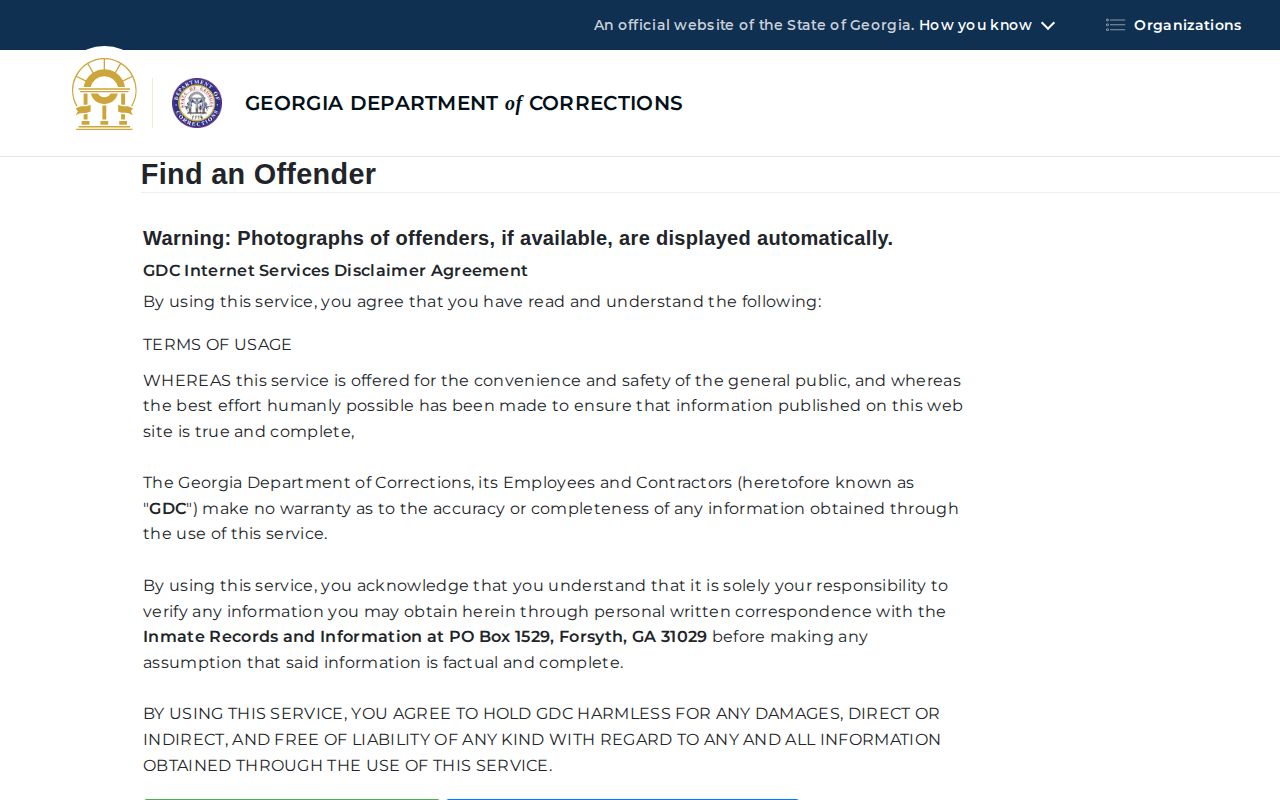
Use its identifiers to confirm the correct state offender, then seek written verification when an official state record is needed.
Franklin Release Supervision Checks
A person can be out of jail yet remain under supervision. The Georgia State Board of Pardons and Paroles offers a tentative parole month lookup and a parolee search. A tentative parole month is a planned review point, not a final release promise. Once a person is on parole or felony probation, the Georgia Department of Community Supervision handles field supervision.
- Parole
- Conditional community release from a prison sentence.
- Felony probation
- Court-ordered community supervision managed by DCS.
- Misdemeanor probation
- Local court supervision that may use the Northern Judicial Circuit Probation Office.
- Discharge
- The recorded end of custody or supervision.
Franklin County is served by the DCS Elberton Field Office, while a Northern Judicial Circuit probation office operates in Carnesville by appointment. The proper office depends on the sentence. Neither office replaces the jail release record or the court disposition.
Funds After a Georgia Release
State-prison release logistics differ from Franklin County jail property procedures. The GDC Release Card information says remaining funds on a released state offender's books are moved to a Progress Card. The person must follow the activation and PIN process. JPay provides card support at 866-777-5729.
This card is not proof that a person left the Franklin County Jail. It applies after GDC custody and belongs to the state-release path. County property, personal effects, and account records should be addressed with the Sheriff's Office. Keeping those channels separate avoids sending a county-only question to the state prison system.
Franklin Release Alerts and Transfers
Georgia VINE can provide custody or case status and release-change alerts where the participating record appears. Search one person, compare identifiers, and register through the options offered by the current interface. VINE is an alert layer, not a full booking packet or permanent Franklin County release archive.
Federal and immigration searches answer narrower questions. The BOP inmate locator can show “Released” or “Not in BOP Custody,” but BOP warns that another justice or supervision system may still hold the person. ICE's locator covers current ICE custody or longer CBP custody. A Franklin County record marked “released to ICE” proves the county transfer, not release into the community.
Franklin Release Search by Status
The source must fit the status being checked. No single screen covers county jail, state prison, community supervision, federal custody, and immigration custody.
| Status | Best first source | What it proves |
|---|---|---|
| Still in Franklin County custody | Sheriff or Detention Center | Current local custody, if confirmed by staff |
| Released from county jail | Sheriff's Open Records | County release date, reason, and destination |
| Transferred to or released from state prison | GDC search and records | State offender status and available release data |
| On parole or felony probation | Parole Board and DCS | Supervision or parole status |
| Federal or ICE custody | BOP or ICE locator | Receiving-system status |
Note: Record the exact field label, source, and date checked because projected dates, holds, and custody locations can change.
Start with county records when the last known location was the Carnesville jail. Move to GDC only when a sentence or transfer points to state custody. A parole search answers whether state parole supervision exists, not whether a person left the county jail at a certain hour. In the same way, a BOP or ICE result speaks only to that receiving system. Keeping the systems in order produces a custody timeline instead of a set of unrelated name matches.
Franklin County Release Facility
The Facility Map identifies one actual local detention facility: the Franklin County Sheriff's Office and Detention Center, also listed by GDC as Franklin County Jail. State, court, supervision, VINE, registry, BOP, and ICE entries are search systems or offices, not additional Franklin County detention facilities.
- Franklin County Jail: holds local arrestees, pretrial detainees, county-sentenced inmates, and temporary holds; releases are confirmed through Sheriff records and the next custody system when transferred.
The facility is at 1 James Little Street in Carnesville. The Sheriff's records office is open Monday through Friday, 8 a.m. to 4 p.m., and the main number is 706-384-2525.